
Skip to content
Inovasense
FPGAASICSoCHardware DesignCyber Resilience ActEU ComplianceXilinxIntel FPGANanoXploreEU Sovereignty

FPGA vs ASIC vs SoC: Engineering Decision Guide 2026 (with EU CRA Compliance)

Inovasense Team 17 min read
FPGA vs ASIC vs SoC: Engineering Decision Guide 2026 (with EU CRA Compliance)

FPGA vs ASIC vs SoC — which silicon architecture should you choose?

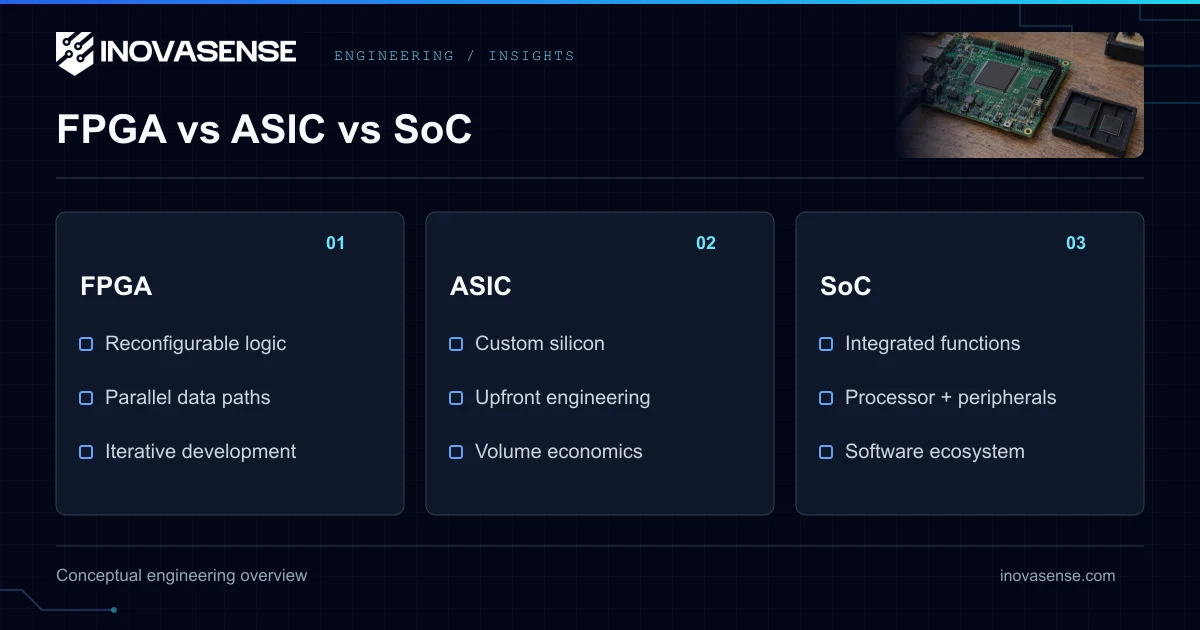
FPGA (Field-Programmable Gate Array) — reconfigurable silicon, NRE €10K–€150K, 3–6 months, ideal for low-to-medium volume and evolving requirements. ASIC (Application-Specific Integrated Circuit) — custom-designed chip, NRE €500K–€10M+, 12–24 months, lowest per-unit cost at volumes above 500K. SoC (System on Chip) — pre-designed silicon integrating CPU, memory, peripherals, and often radio — typically the fastest path for general-purpose Linux-class embedded products. Under EU CRA, FPGA's field-reprogrammability makes vulnerability response easiest; SoC with PSA-Certified silicon reduces conformity effort; ASIC carries highest CRA risk due to fixed silicon. For FPGA-based product development, see our FPGA Design Services.

Why This Decision Matters More Than Ever

The semiconductor landscape in 2026 is defined by four converging forces: the global FPGA market reaching $11.02 billion, the rise of Edge AI demanding hardware-accelerated inference, the EU Cyber Resilience Act requiring secure and updatable firmware in all connected products (full enforcement December 2027), and the EU Chips Act €43 billion push for hardware sovereignty. Whether you’re building a defense radar system, an industrial sensor, or a medical imaging device, the FPGA vs ASIC vs SoC decision is the most consequential architectural choice you’ll make.

Getting it wrong means either overpaying per unit for life (choosing FPGA when ASIC was appropriate), spending millions on NRE only to discover requirements changed (choosing ASIC too early), or facing post-launch CRA vulnerability remediation impossibilities (choosing locked silicon for a security-sensitive product). This guide provides the engineering data and decision framework to get this right.

Head-to-Head: FPGA vs ASIC vs SoC

CriterionFPGAASICSoC
ReconfigurabilityFull — reprogram in field via JTAG or OTAFixed after fabricationFirmware updatable; silicon fixed
Time-to-Market3–6 months (RTL to working hardware)12–24 months (RTL to first silicon)Weeks to months (off-the-shelf silicon)
NRE Cost€10K–€150K (RTL + tools + board)€500K–€10M+ (mask sets + verification + foundry)€30K–€80K (board + firmware)
Unit Cost (10K units)€15–€200 per chip€2–€50 per chip (amortized NRE)€1–€15 per chip (commodity silicon)
Clock Frequency200–800 MHz typical1–5 GHz achievable200 MHz – 3.6 GHz depending on SoC class
Power Efficiency2–10× higher power than equivalent ASICOptimized — lowest power per functionVendor-optimized; varies widely (MCU class to AP class)
Logic DensityUp to 9.4M logic elements (Intel Agilex 9)Virtually unlimited (limited by die area)Pre-fixed by vendor
SecurityBitstream encryption, secure boot, PUF availableTamper-resistant by design, custom security blocksTrustZone, Secure Element integration, PSA Certified options
IP ProtectionBitstream encryptable but extractableMask-level obfuscation — hardest to reverse-engineerApplication code only; silicon IP belongs to vendor
CRA Vulnerability Patch PathSigned bitstream OTA — days to weeksNew mask set required — months to recallFirmware OTA + vendor patch coordination
EU-Sovereign OptionNanoXplore (FR)EU foundries (X-FAB, GlobalFoundries Dresden)STMicroelectronics, NXP, Infineon

For decision-grade specifications and EU-sovereign options across silicon classes, see our FPGA Design Services and EU Hardware Sovereignty capabilities.

When to Choose FPGA

FPGAs are the right choice when one or more of these conditions apply:

1. Your Requirements Will Change

If your product needs post-deployment hardware updates — whether for new protocol support, algorithm improvements, or security patches — FPGA is the only option that doesn’t require a board redesign. This is particularly critical under the EU Cyber Resilience Act, which mandates authenticated firmware updates and vulnerability response throughout a product’s lifecycle (minimum 5 years from market placement).

2. Low-to-Medium Volume Production

For production volumes below 10,000–50,000 units, the NRE savings of FPGA almost always outweigh the higher per-unit cost. The crossover point depends on chip complexity:

Production VolumeFPGA Total CostASIC Total CostWinner
100 units€25,000€2,500,000+FPGA
1,000 units€60,000€2,550,000FPGA
10,000 units€350,000€2,700,000FPGA
50,000 units€1,500,000€3,000,000Depends on complexity
100,000 units€3,000,000€3,500,000Breakeven zone
500,000+ units€15,000,000€5,000,000ASIC

Estimates based on mid-range complexity designs. Actual costs vary by technology node and design.

3. Real-Time Signal Processing

FPGAs excel at massively parallel operations — they can process hundreds of data streams simultaneously with deterministic latency. Typical applications:

  • Radar and sonar processing — Beamforming, pulse compression, CFAR detection
  • Software-defined radio (SDR) — Multi-standard baseband processing
  • High-frequency trading — Sub-microsecond market data parsing
  • Video processing — 4K/8K encoding, computer vision pipelines
  • 5G infrastructure — Massive MIMO, fronthaul processing

4. Defense and Aerospace Applications

Defense and dual-use systems overwhelmingly favor FPGAs for several reasons:

  • Long product lifecycles (20–30 years) requiring hardware updates
  • Low production volumes (hundreds to low thousands)
  • Field-upgradeability for threat response
  • ITAR/dual-use compliance — reprogrammable hardware avoids some export control restrictions
  • Radiation-tolerant FPGA families available (Microchip RTG4, AMD Versal AI Edge, NanoXplore NG-Ultra)

5. Rapid Prototyping and De-Risking

Even if your end goal is ASIC, prototyping on FPGA first reduces risk dramatically. You can validate your RTL design on real hardware, run system-level tests, and iterate — all before committing to a €500K+ mask set.

When to Choose ASIC

ASICs make sense when the design is stable and volume justifies the investment:

1. High-Volume Consumer Products

Smartphones, smartwatches, Wi-Fi routers, Bluetooth earbuds — any product shipping in hundreds of thousands or millions of units. At these volumes, even a €5 per-unit savings on the chip compounds to millions in margin.

2. Extreme Power Constraints

Battery-powered devices where every milliwatt matters. An ASIC can be optimized at the transistor level to eliminate every unnecessary switching event. Typical power savings vs FPGA: 5–10× lower for equivalent functionality.

3. Maximum Clock Frequency

When you need multi-GHz operation — high-speed SerDes, DDR5 memory controllers, or 5G modem basebands — ASICs on advanced nodes (5nm, 3nm) deliver performance that FPGAs simply cannot match.

4. IP Protection Is Critical

If your competitive advantage is in the silicon itself (a proprietary algorithm, a unique sensor interface), ASIC provides far stronger IP protection. Reverse-engineering an ASIC requires electron microscopy and months of work; extracting an FPGA bitstream, while non-trivial, is comparatively easier.

When to Choose SoC

SoCs are the default modern choice for general-purpose embedded products that need a complete computing platform:

1. Linux-Class Embedded Products

If your product needs an operating system, networking stack, GUI, or AI inference framework — choose an SoC. Hardening a custom FPGA SoC from scratch takes years; commodity SoCs like NXP i.MX, Texas Instruments Sitara, or NVIDIA Jetson ship with mature Linux distributions, BSPs, and tooling.

2. Multi-Protocol Connectivity Out-of-the-Box

Wi-Fi + BLE + cellular + Thread/Matter in one chip is fundamentally an SoC story. Espressif ESP32-C6, Nordic nRF5340, NXP i.MX 8M Plus integrate radios that would otherwise require external modules, EMC re-certification, and significant board space.

3. CRA-Compliant Connected Products at Lower Cost

Modern SoCs increasingly ship with built-in security primitives: ARM TrustZone, secure enclaves, hardware random number generators, eFuses for key storage, and PSA Certified Level 2 or higher silicon. These dramatically simplify EU CRA conformity assessment — vendor-provided evidence covers 40–60 % of the security baseline.

4. General-Purpose Embedded with Some Custom Logic

When you need ~80 % standard SoC functionality and ~20 % custom hardware acceleration, SoC FPGA (covered below) is the answer. Pure FPGA is overkill; pure SoC lacks the custom logic capacity.

The Hybrid Approach: FPGA First, ASIC Later

The most sophisticated hardware teams use a phased approach when targeting high-volume:

Phase 1: FPGA Prototype (3–6 months)
├── Validate RTL design on development board
├── Run real-world tests with actual sensors/interfaces
├── Iterate on architecture without NRE penalties
└── Ship initial low-volume production on FPGA

Phase 2: ASIC Conversion (12–18 months)
├── Freeze RTL design based on FPGA-validated architecture
├── Optimize for target technology node
├── Tape out and fabricate
└── Transition production to ASIC at volume crossover

This approach eliminates the biggest risk in ASIC development: designing the wrong thing. By validating on FPGA first, you ensure the RTL is functionally correct before spending millions on fabrication.

SoC FPGA: When You Want Both

SoC FPGA silicon combines a hard processor system (ARM Cortex-A or RISC-V) with programmable FPGA fabric on one die. This is the architecture of choice for advanced industrial, automotive, and defense systems that need both general-purpose computing and custom hardware acceleration.

SoC FPGA FamilyVendorCPUFPGA FabricBest For
Zynq UltraScale+ MPSoCAMD (Xilinx)Quad ARM Cortex-A53 + Cortex-R5UltraScale+High-end industrial, automotive, video
Versal Adaptive SoCAMD (Xilinx)Dual Cortex-A72 + AI Engines7nm VersalEdge AI, 5G, defense radar
Agilex SoCIntel (Altera)Quad Cortex-A53 (HPS)Agilex 5/7/9Datacenter accel, industrial, 5G
PolarFire SoCMicrochipQuad RISC-V (SiFive U54)28nm low-powerSecurity-critical, IoT gateway, rad-tolerant
NG-UltraNanoXplore (EU)Quad Cortex-R52 + dual Cortex-A72NG fabricEU-sovereign space, defense, aerospace

Why SoC FPGA matters for CRA compliance: the hard CPU side typically inherits PSA Certified or SESIP3 security evidence from the silicon vendor, while the FPGA fabric provides field-reprogrammable security patches for the custom logic. This dual-path remediation is the cleanest CRA architecture for security-critical connected products.

EU CRA Compliance: Architecture-Specific Requirements

The EU Cyber Resilience Act (Regulation 2024/2847) full enforcement starts December 11, 2027, with vulnerability reporting obligations kicking in September 11, 2026. The CRA’s eight essential cybersecurity requirements apply identically regardless of silicon architecture — but how each architecture satisfies them differs significantly.

CRA Requirement (Annex I)FPGA ImplementationASIC ImplementationSoC Implementation
Secure-by-default configBitstream contains hardened defaults; no debug ports left open in productionMask-level hardening of factory defaultsVendor BSP + manufacturer firmware hardening
Authenticated updatesSigned bitstream + signed firmware; FPGA verifies both at bootSigned firmware only (silicon fixed); typically MCUboot or vendor SBSFUSigned firmware via MCUboot / vendor mechanism + secure enclave key storage
Vulnerability handling (Art. 14)Field-reprogrammable: bitstream OTA pushes patch in hours-daysSilicon vulnerabilities = no field fix; firmware-layer workarounds onlyFirmware OTA path; vendor-coordinated for SoC-level CVE response
SBOMManufacturer generates; FPGA IP cores require provenance trackingManufacturer generates; silicon IP from foundry per agreementManufacturer + SoC vendor SBOM components combined
Cryptographic confidentialityHard crypto blocks in fabric (AES, SHA, custom); PUF for key derivationCustom silicon blocks; highest tamper resistanceTrustZone + Secure Element + hardware crypto accelerator (vendor-provided)
Integrity protectionBitstream signing + runtime integrity monitorsMask-level tamper resistance + on-die integrity blocksSecure boot chain + measured boot + TPM/SE
Availability under attackHardware watchdog + FPGA hardened fabricSilicon-level resilience by designRTOS/Linux with DoS protection + hardware watchdog
Identity / authenticationPUF + custom crypto for device identityeFuse + custom silicon ID blockSecure Element provisioning + vendor identity attestation

Practical CRA Cost Implication

ArchitectureCRA Compliance Cost (5-year lifecycle)Why
FPGALowest at <50K unitsField-reprogrammable = cheapest Art. 14 response; no recall cost
SoC (PSA Certified)Lowest at >100K unitsVendor pre-certification reduces conformity assessment effort by 40–60 %
SoC (commodity)MediumFirmware patches possible; SoC vendor patch coordination required
ASICHighestSilicon-level vulnerabilities = no field fix; recall risk and EOL provisioning costs

For full Article 14 reporting workflow and conformity assessment options, see our CRA Compliance Checklist and CRA Vulnerability Reporting Guide.

EU Hardware Sovereignty Per Architecture

Under the EU Chips Act (Regulation 2023/1781, €43 billion framework) and the increasing dual-use export-control regime (Delegated Regulation 2025/2003), silicon sovereignty is becoming a real procurement constraint for defense, critical infrastructure, and government-funded projects.

ArchitectureEU-Sovereign OptionsConstraints
FPGANanoXplore (FR) — NG-Large, NG-Ultra, NG-Medium; space-grade and defense-grade silicon manufactured under EU supply chainLower density and clock vs AMD/Intel; limited tooling ecosystem
ASIC fabGlobalFoundries Dresden (DE) — 22FDX, 12LP+; X-FAB (DE) — automotive and analog mixed-signal; STMicroelectronics Crolles (FR) — embedded NVMNo leading-edge nodes (sub-5nm) in EU; advanced AI ASIC fabbed outside EU
SoCSTMicroelectronics (FR/IT) — STM32 family, automotive Stellar; NXP (NL) — i.MX, S32; Infineon (DE) — AURIX, PSoCSubstantial portfolio for industrial / automotive / IoT; smartphone-class application processors remain non-EU
EU-sovereign hybridNanoXplore NG-Ultra (FPGA + Cortex-R52 + Cortex-A72)Top choice for EU defense space-grade with Linux-class compute

For defense and dual-use projects, NanoXplore is currently the most strategically significant — it is the only EU-headquartered FPGA vendor with space-qualified silicon and is aligned with both EU Chips Act objectives and EU dual-use export-control simplification.

2026 FPGA Market Landscape

The FPGA ecosystem has matured significantly:

VendorKey FamilyProcess NodeMax Logic ElementsAI AccelerationNotable Feature
AMD (Xilinx)Versal AI Edge7nm1.9M LUTs400 AI-Engine tilesAdaptive SoC with integrated ARM cores
Intel (Altera)Agilex 97nm (Intel 7)9.4M LEsIntegrated AI Tensor BlocksHighest-density FPGA available
LatticeAvant16nm FD-SOI500K LUTsUltra-low power (as low as 15 mW)
MicrochipPolarFire28nm481K LEsRadiation-tolerant, lowest static power mid-range
EfinixTitanium Ti18016nm180K LEsRISC-V hard core, lowest cost per LUT
NanoXplore (EU)NG-Large / NG-Ultra65nm540K LEEU-sovereign space-grade FPGA

Key trend: The line between FPGA and SoC is disappearing. Modern FPGAs like Versal include ARM Cortex-A72 cores, AI accelerators, and programmable logic on a single die — making them complete platforms, not just programmable logic arrays.

FPGA Design Complexity: What It Actually Takes

A common misconception is that FPGAs are “just programming.” In reality, FPGA development requires deep hardware engineering expertise:

TaskToolsExpertise Required
RTL DesignVHDL or SystemVerilogDigital logic design, FSM design, pipelining
SimulationModelSim, Vivado SimulatorTestbench creation, functional verification
SynthesisVivado, Quartus PrimeTiming closure, resource optimization
Place & RouteVendor toolsFloor planning, timing constraint definition
Timing AnalysisStatic Timing Analysis (STA)Setup/hold violations, clock domain crossing
Board DesignAltium, KiCadHigh-speed PCB layout, power integrity, signal integrity
FirmwareC/C++ (for soft/hard processors)Embedded programming, driver development

This is why many companies outsource FPGA design to specialized teams. The combined skillset spans digital design, analog electronics, embedded software, and PCB engineering — a rare combination to find in a single team.

Common Mistakes in the FPGA vs ASIC vs SoC Decision

MistakeConsequenceBetter Approach
Choosing ASIC for a v1 product with uncertain requirements€2M+ NRE wasted if requirements changePrototype on FPGA first, convert to ASIC at v2
Choosing the cheapest FPGA without marginDesign won’t fit after adding featuresSelect FPGA with ≥30 % resource headroom
Ignoring CRA Article 14 patch path in architecturePost-launch silicon-level vulnerability = recallInclude vulnerability remediation analysis in architecture decision
Selecting non-PSA-Certified SoC for connected productHigher CRA conformity assessment effort and riskDefault to PSA Level 2+ silicon for CRA-scope products
Ignoring power budget in FPGA selectionBattery life falls short of specModel power consumption early using vendor tools
Assuming FPGA = no hardware designPCB and power delivery failBudget for proper high-speed PCB design
Skipping timing constraintsIntermittent failures in productionDefine all clocks, I/O timing, and multicycle paths
Treating SoC vendor as silent CRA partnerVendor cannot patch issues you don’t report; assumed responsibility gapsEstablish explicit CRA support agreement with SoC vendor before committing

Quick Decision Framework

Use this sequence:

  1. Production volume? Below 50K → FPGA shortlist. Above 500K → ASIC shortlist. Between → SoC primary, FPGA where custom logic needed.
  2. CRA risk class? Important Class II / Critical → Notified Body required; favor architectures with vendor PSA Certified evidence or field-reprogrammable patch capability.
  3. Functional safety needed? ISO 26262 / IEC 61508 / DO-254 → adds documentation overhead; favor architectures with safety-certified silicon (Microchip PolarFire SoC, STM32 Safety, AMD Versal Functional Safety).
  4. EU sovereignty mandate? Defense/critical infrastructure → NanoXplore (FPGA) or STM32/NXP (SoC) primary; non-EU silicon only with justification.
  5. Field-upgradability priority? Yes → FPGA or SoC FPGA. No (consumer fixed-function) → ASIC at volume.

The output should be a shortlist of 2–3 silicon candidates matching your decision path. Final selection should always include hands-on evaluation board work and quoted pricing from at least two vendors.

Our FPGA, ASIC, and SoC Expertise

At Inovasense, silicon architecture decision-making is one of our core services. We work across the full silicon spectrum — from RTL architecture through PCB design to production:

  • FPGA design services — AMD Versal, Intel Agilex, Lattice Avant, Microchip PolarFire, and EU-sovereign NanoXplore
  • SoC FPGA integration — Zynq UltraScale+, Agilex SoC, PolarFire SoC with full Linux BSP
  • FPGA-to-ASIC conversion — phased migration when volume justifies the investment
  • Signal processing pipelines — radar, sonar, communications, and Edge AI inference
  • Defense and dual-use platforms — rugged designs with security features and EU export-compliance documentation
  • EU compliance — CRA, RED, AI Act conformity assessment alongside silicon architecture

Whether you need a complete FPGA-based system, an SoC integration, or an FPGA-to-ASIC migration path, we bring the full hardware development methodology to ensure your design is correct, manufacturable, and certifiable. Contact us to discuss your silicon architecture decision.