
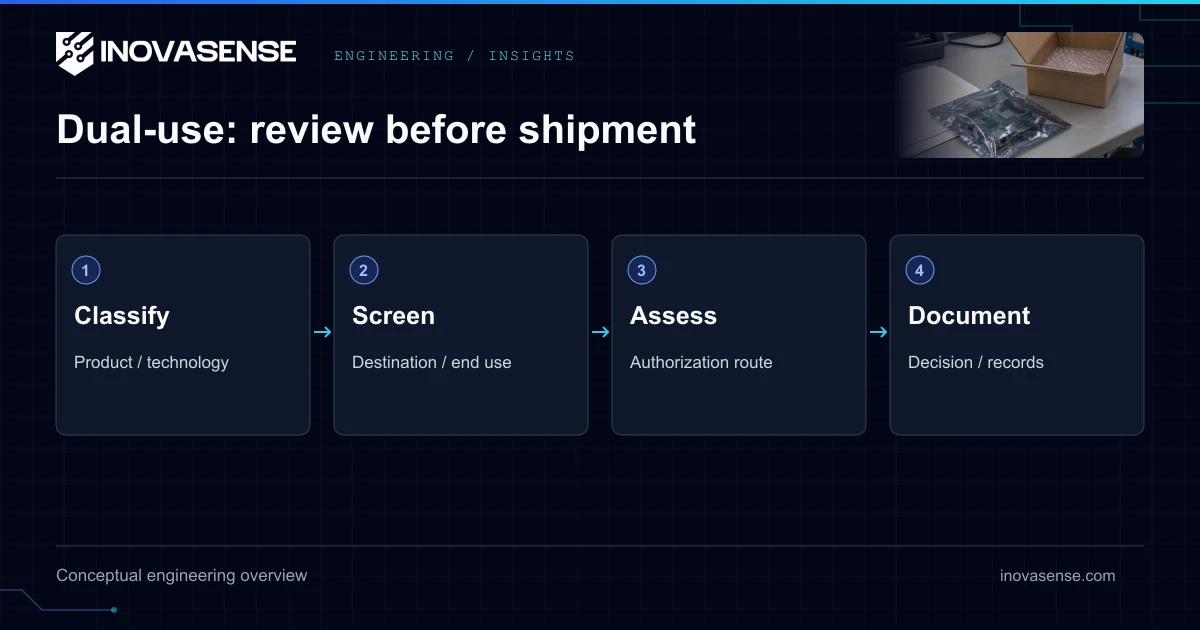
A commercial FPGA or development board is not automatically unrestricted, and an entire device family is not automatically controlled. EU dual-use classification requires the exact technical characteristics, software and technology, destination and end use. Use the version of the control list applicable to the transaction.
Classify the item and the transaction
Regulation (EU) 2021/821 provides the framework and Annex I control list. Match the complete product and relevant components against the applicable entries, technical notes and exclusions. Electronics, computers, telecommunications and information security can require different entries. A vendor classification is useful evidence but does not replace the exporter’s assessment of its configuration and transaction.
Do not use a universal logic-element or clock-frequency threshold for all FPGAs. Custom firmware or IP can change the function of a system; it does not mean every AES implementation or every AI block is automatically controlled. Classification depends on the entry and relevant notes, including treatment of publicly available technology and information-security items.
Unlisted items can still require action
Check catch-all provisions, including specified prohibited end uses and relevant cyber-surveillance conditions, together with national controls. Review sanctions separately: a control-list classification alone cannot authorise a prohibited transaction.
Record consignee, end user, destination, end use and red flags. Recheck when product capability, parties or destination change. A civilian marketing description does not establish civilian end use.
Software, source code and remote access
Export can include transmission of controlled software or technology electronically to a destination outside the EU customs territory, not only shipment of boards. Assess repository permissions, remote access, cloud storage, design files, FPGA IP and technical assistance.
Do not import the US “deemed export” concept as a blanket EU rule based solely on an engineer’s citizenship. EU destination, disclosure and technical-assistance provisions, national law and any separately applicable US-origin restrictions need their own assessment. EU headquarters do not eliminate these obligations.
Choose the correct authorisation
Depending on the item and transaction, a Union general, national general, global or individual authorisation may be available. A general authorisation is still an authorisation with conditions, excluded items, destinations and notification/registration duties; it is not “uncontrolled” or automatically licence-free.
Annex II contains the precise conditions. For example, EU002 concerns specified items to specified destinations; EU003 concerns export after repair or replacement; EU004 concerns temporary export for exhibitions or fairs. Do not substitute one for another, and verify the current annex and national implementation before use.
Intra-EU transfers and records
Article 11 requires authorisation for Annex IV intra-Union transfers; other specified conditions can also matter. EU supply-chain location therefore does not guarantee all transfers are unrestricted.
Article 27 requires export, brokering and technical-assistance records for at least five years from the end of the relevant calendar year; listed intra-Union transfer records have their own minimum. Check additional national requirements. Maintain classification rationale, technical specifications, screening, authorisation basis and shipment/access records. Penalties follow Member State law rather than one universal EU €500,000 or prison-term figure.
A practical engineering handover
Provide the compliance owner with the exact part/BOM, firmware functionality, performance parameters, IP origin, software licences, destination and intended use. Obtain the necessary authorisation before shipping or releasing controlled technology. Inovasense can support technical classification inputs and controlled project handovers; formal decisions and authorisations remain with the responsible parties and authorities.
FPGA/ASIC architecture · Defence and dual-use engineering · Discuss your project
Frequently asked questions
Are FPGA development boards always exempt?
No. Assess the exact item, software, technical characteristics, destination and end use against the current list and other applicable controls. Commercial availability alone is not an exemption.
Does EU001 make an export uncontrolled?
No. It is a Union general export authorisation subject to its scope, exclusions and conditions, including applicable registration, notification and record duties.
Is access by a non-EU citizen always an EU deemed export?
No. Do not equate US terminology with a blanket EU citizenship rule. Assess destination and disclosure, controlled technology, technical assistance, national law and separately applicable regimes.
Are all intra-EU transfers unrestricted?
No. Annex IV transfers require authorisation under Article 11, and other relevant conditions, national rules and sanctions must also be checked.
Primary sources
Technical and regulatory references checked on 1 October 2026.