

- Service Definition
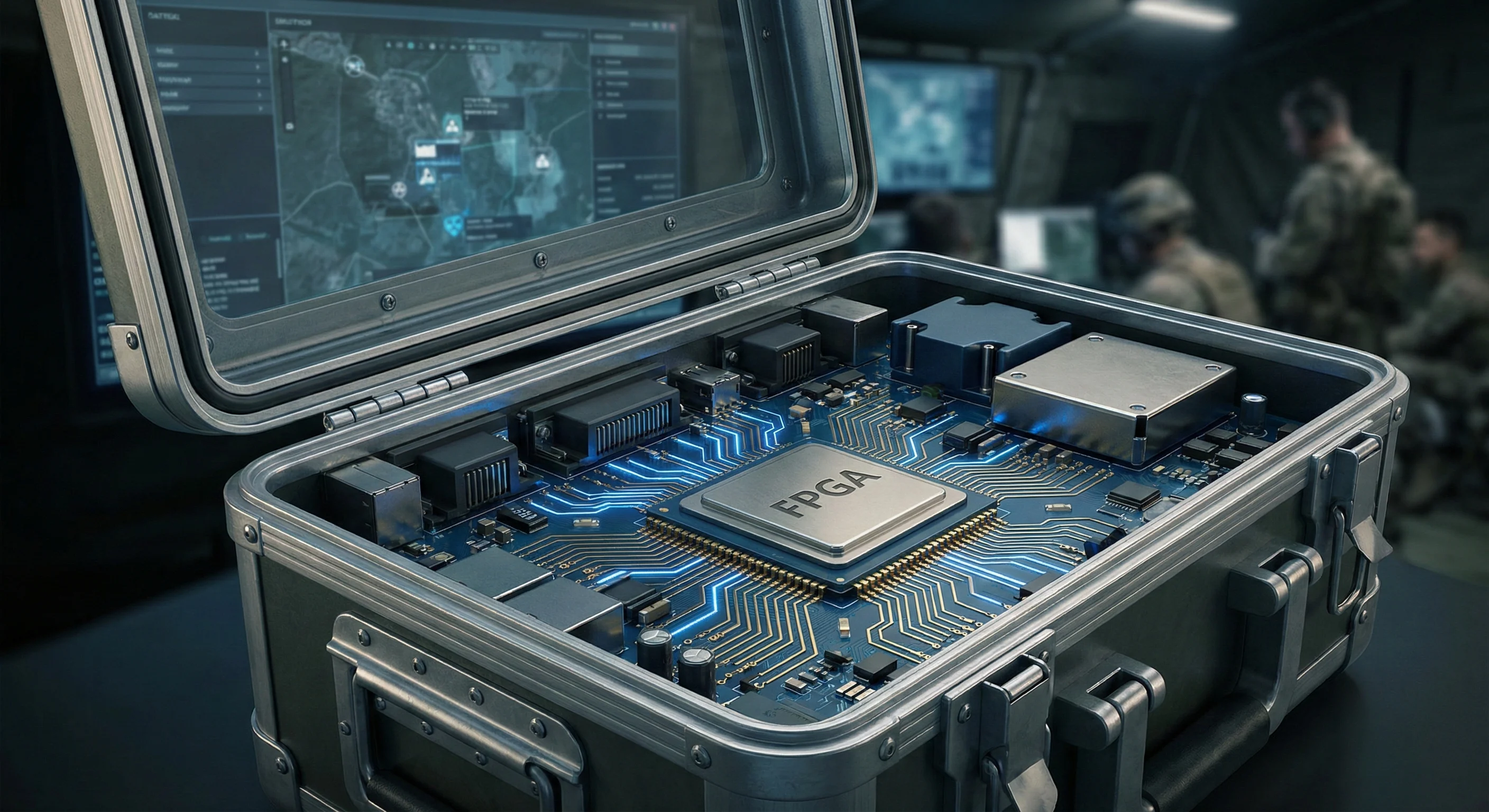
- Ruggedized MIL-STD-810H electronics, export-compliant under EU 2021/821. Tactical comms to autonomous surveillance via EU partners.
Defense & Dual-Use Technology — Managed End-to-End
What is Defense & Dual-Use Technology?
Defense & Dual-Use Technology encompasses hardware and systems designed for both civilian and military applications. Examples include high-end FPGAs, thermal imaging, and secure communications equipment. In the EU, these technologies are strictly regulated under the Dual-Use Regulation (2021/821) to ensure EU hardware sovereignty.
Dual-use technology refers to hardware and systems designed for both civilian and military/defense applications. Under the EU Dual-Use Regulation (EU 2021/821) and the 2025 control list update, technologies including FPGAs above certain logic capacity thresholds, cryptographic accelerators, quantum sensors, and advanced AI systems are subject to export licensing requirements.
Inovasense manages projects delivering ruggedized, mission-critical hardware for demanding operational environments — from defense and aerospace to critical infrastructure, border security, counter-UAS, and industrial hazardous zones. We coordinate specialized EU-based engineering partners while our in-house team oversees architecture, compliance, and quality. Every project targets MIL-STD environmental standards while remaining export-compliant and adaptable for civilian deployment.
What Makes Defense-Grade Hardware Different?
Defense electronics must operate reliably in conditions that would destroy commercial-grade equipment:
| Parameter | Commercial | Industrial | Defense (MIL-STD) |
|---|---|---|---|
| Operating temperature | 0°C to +70°C | -40°C to +85°C | -55°C to +125°C |
| Vibration | Office environment | Factory floor | 20g, 10–2000 Hz (MIL-STD-810H Method 514.8) |
| Shock | Drop from desk | Forklift handling | 40g, 11 ms half-sine (Method 516.8) |
| Humidity | Controlled | Condensing | 95% RH, aggravated cycling (Method 507.6) |
| EMI/EMC | EN 55032 Class B | EN 55032 Class A | MIL-STD-461G RE102/RS103 |
| Sand & dust | N/A | IP65 | Blowing sand (Method 510.7) |
| Salt fog | N/A | Limited | 5% NaCl, 35°C (Method 509.7) |
| Altitude | Sea level | — | 40,000 ft (Method 500.6) |
| Design lifetime | 3–5 years | 7–10 years | 15–25 years |
Ruggedization Approach
Through our partner network, projects follow established defense-grade practices:
- Component derating — All components operated at ≤80% of rated maximum to ensure long-term reliability
- Conformal coating — Acrylic or polyurethane coatings (IPC-A-610 Class 3) protecting against moisture, fungus, and contamination
- Potting & encapsulation — Silicone or epoxy fills for extreme vibration environments
- Thermal management — Conduction-cooled designs eliminating fans and moving parts; CFD-validated thermal paths. See our Industrial Design capabilities.
- HALT/HASS — Highly Accelerated Life Testing during development, Highly Accelerated Stress Screening in production
- Radiation-tolerant design — SEU mitigation techniques for high-altitude and space-adjacent applications, leveraging FPGA TMR (Triple Modular Redundancy)
Defense & Dual-Use Application Areas
Our partner network has experience across the following domains:
Secure Communication Systems
End-to-end encrypted communication hardware leveraging Embedded Security principles:
- Hardware-encrypted radios — FPGA-based wideband SDR with encryption and post-quantum cryptography (ML-KEM, ML-DSA)
- Tactical mesh networks — Self-healing, frequency-hopping MANET nodes with anti-jam capabilities
- Satellite ground terminals — L-band, Ku-band, and Ka-band modem hardware for SATCOM, including LEO constellation terminals (Iris² program)
- Cross-domain solutions — Hardware-enforced data diodes and one-way transfer devices for classified network boundaries
- Quantum Key Distribution (QKD) — Integration readiness for emerging EuroQCI quantum communication infrastructure
FPGA-Based Defense Processing
Custom, deterministic real-time signal processing with no software attack surface:
- Radar signal processing — Pulse compression, MTI, CFAR detection, digital beamforming on platforms like AMD Versal AI Edge
- Electronic warfare — Wideband signal detection, direction finding, and response generation
- SIGINT — Wideband spectrum monitoring, protocol identification, cognitive electronic support measures (ESM)
- Navigation — GPS anti-jam (CRPA) processing, INS/GPS/Galileo fusion, spoofing detection, and PNT resilience
Counter-UAS Systems
Addressing one of the fastest-growing defense sectors — countering unmanned aerial systems:
- RF detection & classification — Wideband SDR-based detection of drone control links (2.4/5.8 GHz, 900 MHz)
- Radar integration — Compact mmWave radar for micro-drone detection
- Acoustic detection — MEMS microphone arrays with neural network-based drone signature recognition
- EO/IR tracking — Thermal and visible camera fusion with AI-powered tracking algorithms
- Electronic countermeasures — Protocol-aware jamming of commercial drone control channels
- Sensor fusion C2 — Command and control software integrating all sensor modalities into a common operating picture
Edge AI for Situational Awareness
On-device AI inference for real-time threat assessment:
- Video analytics — Person/vehicle detection and tracking on platforms like NVIDIA Jetson Orin in SWaP-constrained deployments
- Acoustic threat detection — Gunshot detection, explosion classification, drone acoustic signature recognition
- Multi-sensor fusion — EO/IR, radar, acoustic, and RF data fusion for comprehensive situational awareness
- Predictive maintenance — Vibration and thermal anomaly detection for vehicle and equipment health monitoring
- Autonomous navigation — SLAM, visual odometry, and path planning for UGV/UAV platforms
Export Compliance & Regulatory Framework (2026)
| Regulation | Scope | How We Help |
|---|---|---|
| EU Dual-Use Regulation (EU 2021/821) | Export of dual-use items from EU | Classification against Annex I, export license support |
| 2025 Control List Update | New controls on FPGAs >50K LUT, quantum tech, AI systems | Proactive monitoring and classification |
| Wassenaar Arrangement | Multilateral export controls | Alignment with all categories |
| NATO STANAG | Interoperability standards | Design to STANAG specs (e.g., 4609, 4586, 5066) |
| EU Cyber Resilience Act | Connected defense products sold commercially | CRA-compliant development lifecycle |
| ITAR considerations | US-origin technology restrictions | EU-origin design approach minimizes ITAR entanglement |
Classification & Licensing Support
We assist clients with:
- ECN (Export Control Number) assignment for all hardware subsystems
- End-use statement preparation and documentation
- Technology transfer documentation for international programs
- Catch-all clause assessment for emerging technology exports
- Intangible technology transfers — Compliance for electronic transmission of controlled technical data
EU Defense Industrial Programs
Inovasense monitors and aligns with the EU’s growing defense industrial base:
- EDIP (European Defence Industry Programme) — EU-funded collaborative defense R&D
- EDIRPA — European Defence Industry Reinforcement through common Procurement Act
- Permanent Structured Cooperation (PESCO) — Support for PESCO member state projects
- European Defence Fund (EDF) — Collaborative research and capability development
- NATO DIANA — Deep-tech innovation accelerator for dual-use technologies
Why Work With Inovasense on Defense Projects?
- EU-based & sovereign — Projects developed within the EU, ensuring ITAR independence and data sovereignty
- Regulatory navigation — Deep understanding of FPGAs, cryptographic accelerators, and sensor systems under the 2025 dual-use control list
- Single point of contact — We manage the full project lifecycle from concept through MIL-STD-810H environmental testing to production transfer
- Vetted partner network — Access to specialized defense engineering capabilities across the EU without building your own vendor management
- Cross-domain synergies — Defense projects benefit from civilian IoT, embedded security, and Edge AI advances in our partner network
- Flexible engagement — From consulting and architecture reviews to full project management
Applications
- Counter-UAS — Multi-sensor drone detection, tracking, and electronic countermeasure systems
- Unmanned Autonomous Systems (UAS) — UAV avionics, ground robot control, autonomous waypoint navigation
- Secure Communications — PQC-encrypted tactical radios, satellite terminals, network-centric warfare
- ISR (Intelligence, Surveillance, Reconnaissance) — Multi-sensor fusion platforms, persistent surveillance
- Critical Infrastructure Protection — Perimeter security, SCADA/ICS hardening, resilient communications
- Electronic Warfare — SDR platforms, SIGINT, cognitive electronic support, spectrum monitoring
- Border Security — Ground-based sensor networks, maritime domain awareness, mobile surveillance units
Sources & Official References
- Cyber Resilience Act — Regulation (EU) 2024/2847 — EUR-Lex (Official Journal of the EU)
- EU Dual-Use Regulation — Regulation (EU) 2021/821 — EUR-Lex (Official Journal of the EU)
Guides in this area
Frequently Asked Questions
What is dual-use technology?
Dual-use technology refers to hardware and systems that have both civilian and military applications — such as high-end FPGAs, cryptographic accelerators, thermal imaging, and secure communications equipment. In the EU, these technologies are regulated under the Dual-Use Regulation (EU 2021/821) and require export licenses for certain destinations.
What is MIL-STD-810H?
MIL-STD-810H is the US Department of Defense standard for environmental engineering testing. It defines test methods for extreme temperature (-55°C to +125°C), vibration (20g), shock (40g), humidity, sand, dust, salt fog, and altitude. Inovasense manages projects delivering ruggedized electronics that meet MIL-STD-810H requirements for defense and harsh environment deployments.
How does Inovasense handle export compliance for dual-use items?
Inovasense assists with Export Control Number (ECN) assignment, end-use statement preparation, technology transfer documentation, and catch-all clause assessment under the EU Dual-Use Regulation (2021/821) and the Wassenaar Arrangement. Our EU-origin approach minimizes ITAR entanglement.