
Skip to content
Inovasense
IoT Security: HW Engineer's Guide - Inovasense
IoT SecurityIIoTEmbedded SecurityHardware SecurityIEC 62443Cyber Resilience ActSecure BootTPM

IoT Security: HW Engineer's Guide

Inovasense Team 17 min read
IoT Security: HW Engineer's Guide

What are the most important IoT security best practices?

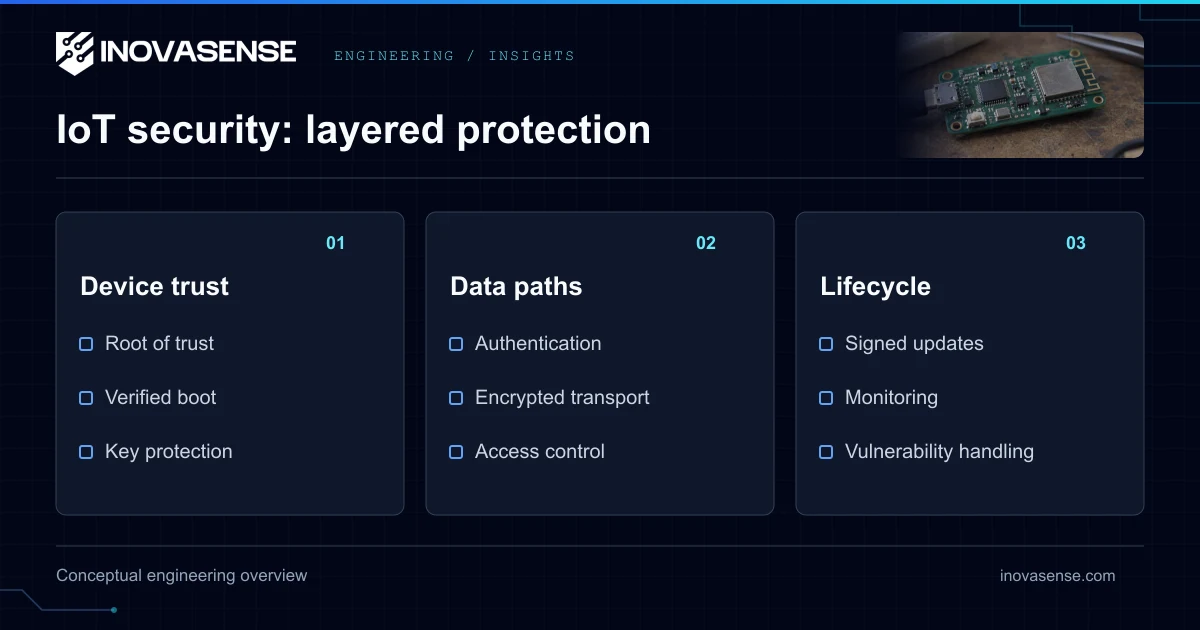
Effective IoT security in industrial systems requires hardware-rooted trust, not just software measures. The five non-negotiable practices are: 1) hardware root of trust (TPM or secure element) for identity and key storage, 2) authenticated secure boot chain from hardware to application, 3) encrypted communications with mutual TLS/DTLS, 4) signed, rollback-protected firmware updates (OTA), and 5) network segmentation isolating OT from IT. For hardware security design services, see our Embedded Security & IoT practice.

What Competitors Won’t Tell You About IoT Security

Most IoT security guides focus on IT security applied to IoT — firewalls, patching, access control, Zero Trust. These are necessary but insufficient for industrial systems.

Here’s what they miss:

What competitors cover ❌What actually matters ✅
“Change default passwords”Hardware root of trust — passwords can be extracted from flash; secure elements cannot be read
”Use encryption”Key management lifecycle — where are keys generated, stored, rotated, and revoked?
”Keep software updated”Authenticated firmware updates — how do you prevent a malicious update from bricking 10,000 devices?
”Segment your network”Physical tamper protection — what happens when someone has physical access to the device?
”Run antivirus”There is no antivirus for embedded systems — security must be designed into the hardware
”Monitor for anomalies”A compromised device can lie — only hardware attestation proves device integrity

This guide addresses IoT security from the hardware up — the perspective that matters when you’re designing products, not just deploying them.

The Real Cost of Getting It Wrong

Industrial IoT security failures aren’t abstract — they have quantifiable consequences:

IncidentImpactRoot Cause
Triton/TRISIS (2017)Attempted explosion at Saudi petrochemical plantMalware targeting safety instrumented systems (SIS)
Colonial Pipeline (2021)$4.4M ransom, US fuel supply disrupted for 6 daysCompromised VPN credential, no MFA on OT access
Verkada cameras (2021)150,000 cameras compromised (Tesla, hospitals, prisons)Hardcoded admin credentials in firmware
Oldsmar water (2021)Attempted poisoning of water supply (sodium hydroxide 100×)Remote access to SCADA without authentication
MOVEit (2023)2,500+ organizations breachedUnpatched file transfer appliance

Common thread: Every major IIoT breach exploited either missing hardware security, unpatched software, or inadequate access control. Software-only security failed in every case.

Average cost of an industrial security breach: €4.7 million (IBM Cost of a Data Breach 2025). For critical infrastructure, the cost can include human safety.

The Security Architecture Stack

Securing an industrial IoT device requires defense at every layer:

┌────────────────────────────────────────────┐
│          CLOUD / BACKEND SECURITY          │
│  API authentication, certificate management│
│  Device fleet management, audit logging    │
├────────────────────────────────────────────┤
│          APPLICATION SECURITY              │
│  Input validation, secure coding, SBOM     │
│  Encrypted storage, access control         │
├────────────────────────────────────────────┤
│          COMMUNICATION SECURITY            │
│  Mutual TLS, DTLS, encrypted MQTT          │
│  Certificate pinning, key rotation         │
├────────────────────────────────────────────┤
│          FIRMWARE SECURITY                 │
│  Signed updates, rollback protection       │
│  Secure bootloader, code signing           │
├────────────────────────────────────────────┤
│          OS / RTOS SECURITY                │
│  Memory protection, privilege separation   │
│  Secure storage API, watchdog              │
├────────────────────────────────────────────┤
│       ★ HARDWARE SECURITY (Foundation) ★   │
│  Secure element / TPM, secure boot ROM     │
│  Hardware RNG, tamper detection, PUF       │
│  Fused keys, debug port lockdown           │
└────────────────────────────────────────────┘

Key principle: Security flows upward. If the hardware layer is compromised, every layer above it is compromised. This is why hardware security is the foundation, not an afterthought.

Best Practice 1: Hardware Root of Trust

The most critical decision in IoT security design is establishing a hardware root of trust — an immutable, tamper-resistant component that serves as the security anchor for the entire system.

TPM vs Secure Element vs MCU-integrated: Which to Use?

FeatureDiscrete TPMSecure ElementMCU-Integrated (TrustZone/PSA)
StandardsTCG TPM 2.0 (ISO 11889)CC EAL5+/EAL6+PSA Certified (Level 1–3)
Key storageRSA/ECC keys, sealed storageECC/AES keys, X.509 certsIsolated secure enclave
Tamper resistanceMedium (discrete chip)High (designed for physical attacks)Low–Medium (shared die)
Cost€2–€8 per unit€0.50–€3 per unit€0 (built into MCU)
Crypto performanceModerate (I2C/SPI bus bottleneck)ModerateFast (on-die)
Best forPC/server-class devices, Linux systemsIoT devices, smart cards, constrainedCost-sensitive MCU designs
Example chipsInfineon SLB 9670, Microchip ATECC608BNXP SE050, Infineon OPTIGA Trust MSTM32U5 (TrustZone), nRF5340

When to Use Which

  • Battery-powered IoT sensor → MCU-integrated TrustZone (lowest cost, acceptable for PSA Level 2)
  • Industrial gateway → Discrete TPM 2.0 (TCG standard, auditable, Linux support)
  • Payment terminal or critical infrastructure → Secure Element (CC EAL5+, highest tamper resistance)
  • FPGA-based system → FPGA bitstream encryption + external secure element for key storage

Implementation Checklist

□ Unique device identity (X.509 certificate per device, not per batch)
□ Private key generated on-chip (never leaves the secure element)
□ Hardware RNG for key generation (not software PRNG)
□ Monotonic counter for rollback protection
□ Debug port (JTAG/SWD) disabled in production firmware
□ Fuse bits set to prevent flash readout
□ Tamper detection GPIO (optional, for high-security applications)

For detailed implementation patterns, see our Embedded Security & IoT service page.

Best Practice 2: Secure Boot Chain

A secure boot chain ensures that only authenticated, untampered code runs on the device, from power-on to application:

 Power On

 1. Boot ROM (immutable, in silicon)
    → Verifies bootloader signature using OTP fused public key

 2. Bootloader (first updatable stage)
    → Verifies firmware image signature (ECDSA P-256 or Ed25519)
    → Checks rollback counter (prevents downgrade attacks)

 3. Firmware / RTOS
    → Verifies application integrity
    → Initializes secure storage

 4. Application
    → Establishes TLS connection to backend
    → Normal operation begins

Common Secure Boot Mistakes

MistakeConsequenceFix
Storing signing key alongside firmwareAttacker extracts key, signs malicious firmwareKey in secure element only, never in flash
No rollback protectionAttacker flashes old vulnerable firmwareMonotonic counter in OTP fuses
Verifying only the first stageLater stages can be modified undetectedChain of trust — each stage verifies the next
Debug port left open in productionJTAG/SWD bypasses entire boot chainFuse JTAG disable before deployment
Using SHA-256 only (no signature)Hash can be recalculated for modified firmwareUse ECDSA or Ed25519 signature verification

FPGA-Specific Secure Boot

FPGAs have unique secure boot requirements because the entire hardware configuration is loaded at power-on:

  1. Bitstream encryption — AES-256 encryption of the FPGA configuration file
  2. Bitstream authentication — RSA/ECDSA signature verification before loading
  3. Key storage — eFUSE or battery-backed RAM for encryption keys
  4. Fallback — golden/recovery bitstream if primary authentication fails
  5. Partial reconfiguration — update only portions of the FPGA without reloading everything

AMD/Xilinx and Intel/Altera FPGAs both support these features natively. Our FPGA Design Services include security architecture from the beginning of every project.

Best Practice 3: Encrypted Communications

Every data path in an IoT system must be encrypted and authenticated:

Protocol Selection for Industrial IoT

ProtocolSecurityOverheadBest ForRecommendation
MQTT + TLS 1.3StrongMedium (TCP + TLS)Cloud-connected devices, telemetry✅ Default choice for IP-capable devices
MQTT-SN + DTLSStrongLower (UDP-based)Constrained devices, lossy networks✅ Good for LoRaWAN/NB-IoT
CoAP + DTLSStrongLowRESTful constrained devices✅ Alternative to MQTT for request/response
OPC UAStrong (built-in)HighIndustrial automation, SCADA✅ Standard for factory floor
Modbus TCP❌ None nativelyLowLegacy industrial⚠️ Wrap in VPN or TLS tunnel
BLEMedium (AES-CCM)LowShort-range sensors⚠️ Adequate for non-critical data
LoRaWANAES-128 (built-in)Very lowLPWAN sensors✅ Acceptable for sensor data

Mutual TLS: Why Server-Only TLS Is Not Enough

Standard HTTPS/TLS authenticates only the server. In IoT, the device must also authenticate to the server (mutual TLS / mTLS):

Standard TLS:
  Device → "I trust you, server" (verifies server certificate)
  Server → "I don't know who you are" (accepts any client)

Mutual TLS:
  Device → "I trust you, server" (verifies server certificate)
  Server → "Prove you're a real device" (verifies device certificate)
  Device → Presents X.509 certificate from secure element
  Server → Verified — connection established

Why mTLS matters: Without device authentication, an attacker can impersonate a device, inject false sensor data, or exfiltrate commands intended for legitimate devices.

Key Rotation and Certificate Lifecycle

 Manufacturing → Device provisioned with initial certificate

 Deployment → Certificate registered with IoT platform

 Operation → Certificates rotated every 1-2 years

 Decommission → Certificate revoked, device wiped

Keys should never be shared across devices. Each device gets a unique keypair generated in its secure element during manufacturing.

Best Practice 4: Secure Firmware Updates (OTA)

The ability to update deployed devices is both a security requirement and a security risk. A compromised update mechanism gives attackers root access to your entire fleet.

OTA Update Security Requirements

RequirementPurposeImplementation
Code signingVerify update authenticityECDSA-P256 or Ed25519 signature
EncryptionPrevent reverse engineering of firmwareAES-256 encryption of update package
Rollback protectionPrevent downgrade to vulnerable versionMonotonic counter in OTP/secure element
Atomic updatePrevent bricking from interrupted updateA/B partition scheme or delta updates
Version verificationEnsure correct firmware for correct deviceHardware ID + version check before apply
Audit trailTrack update status across fleetBackend logging of per-device update status

A/B Update Architecture

 Flash Layout:
 ┌────────────────┐
 │   Bootloader   │  Verifies active partition
 ├────────────────┤
 │  Partition A   │  ← Currently running (v2.1)
 ├────────────────┤
 │  Partition B   │  ← New update written here (v2.2)
 ├────────────────┤
 │  Secure Store  │  Keys, certificates, config
 └────────────────┘

 Update Process:
 1. Download v2.2 to Partition B (while v2.1 runs)
 2. Verify signature of v2.2
 3. Check rollback counter (v2.2 > v2.1 ✓)
 4. Mark Partition B as "pending"
 5. Reboot → bootloader tries Partition B
 6. If boot succeeds → mark B as "active"
 7. If boot fails → rollback to Partition A automatically

This is not optional — the EU Cyber Resilience Act mandates authenticated firmware updates for all connected products sold in the EU from 2027. See our CRA Compliance Checklist.

Best Practice 5: Network Segmentation and Zero Trust

The Purdue Model for Industrial Networks

Industrial networks should follow layered segmentation:

 Level 5: Enterprise    │ ERP, email, internet
 ───── DMZ ─────────────┤ Firewall + IDS
 Level 4: Business      │ MES, historian, reporting
 ───── DMZ ─────────────┤ Industrial firewall
 Level 3: Operations    │ HMI, SCADA, engineering
 ────────────────────────┤ Managed switch + ACL
 Level 2: Control       │ PLCs, DCS, RTUs
 ────────────────────────┤ Physical isolation
 Level 1: Field         │ Sensors, actuators, drives
 Level 0: Process       │ Physical equipment

Zero Trust for OT — Practical Implementation

Zero Trust in industrial environments doesn’t mean “authenticate everything with MFA” — some devices don’t even have a screen. Practical Zero Trust for OT means:

  1. Network micro-segmentation — each device or device group in its own VLAN
  2. Device identity — X.509 certificate-based authentication (not passwords)
  3. Least privilege — devices can only communicate with their controller, not with each other
  4. Encrypted east-west traffic — inter-device communication encrypted even inside the OT network
  5. Continuous monitoring — anomaly detection on traffic patterns (not payload inspection, which breaks real-time)
  6. No implicit trust — a device authenticated 5 minutes ago must re-authenticate if its behavior changes

Best Practice 6: Physical Security (The Forgotten Layer)

Most IoT security guides stop at the network. But industrial devices are deployed in physically accessible locations — factory floors, utility cabinets, outdoor installations.

Physical Attack Surface

Attack VectorRiskMitigation
Debug ports (JTAG/SWD)Full firmware extraction, key dumpFuse disable, cover with epoxy in production
Flash readoutFirmware reverse engineeringFlash read protection bits + encrypted firmware
Bus sniffing (I2C/SPI to secure element)Key extraction during operationUse encrypted bus communication or on-die integration
Side-channel (power analysis, EM emanation)Key extraction from crypto operationsConstant-time crypto, hardware countermeasures
Fault injection (voltage glitching, laser)Bypass secure boot, skip authenticationRedundant checks, glitch detectors, secure elements with FI protection
Device replacementSubstitute compromised deviceDevice attestation + fleet management

PCB-Level Security Measures

For high-security industrial designs, consider:

  • Tamper-evident enclosures — physical seals that show if device was opened
  • Tamper-responsive — active mesh over sensitive components, wipes keys on breach
  • Conformal coating — protects PCB traces from probing
  • BGA packages — ball grid array components are harder to probe than QFP
  • Potting compound — encapsulate security-critical components in epoxy

EU Regulatory Compliance

EU Cyber Resilience Act (CRA) — Hardware Requirements

The CRA (effective 2027) imposes specific obligations on hardware manufacturers:

CRA RequirementHardware Implementation
Security by designHardware root of trust, secure boot from ROM
Vulnerability handlingOTA update capability, PSIRT process
SBOM (Software Bill of Materials)Include firmware components, bootloader version, crypto libraries
No known exploitable vulnerabilities at releasePre-release security testing, penetration testing
Authenticated updates throughout lifecycleSigned OTA, rollback protection, A/B partitioning
Report actively exploited vulnerabilities within 24hIncident response plan, fleet monitoring

IEC 62443 — Industrial Automation Security

The international standard for industrial cybersecurity defines Security Levels (SL):

LevelMeaningHardware Requirements
SL 1Protection against casual violationPassword protection, basic access control
SL 2Protection against intentional violation with low resourcesUnique identity, signed firmware, TLS
SL 3Protection against sophisticated attack with moderate resourcesHardware root of trust, tamper detection, mTLS
SL 4Protection against state-level attack with extended resourcesSecure element (EAL5+), active tamper response, formal verification

For projects targeting IEC 62443 SL 3+, hardware security design must be incorporated from the architecture phase. See our EU Compliance Guide.

ETSI EN 303 645 — Consumer IoT Security

The European baseline standard for consumer IoT mandates:

  • No universal default passwords
  • Implement means to manage vulnerability reports
  • Keep software updated
  • Securely store sensitive security parameters
  • Communicate securely
  • Minimize exposed attack surfaces

Security Verification and Testing

Pre-Production Security Testing Checklist

□ Penetration testing (firmware extraction, debug port access)
□ Fuzzing (protocol parsers, firmware update handler)
□ Side-channel analysis (if handling high-value keys)
□ Secure boot bypass testing (glitching, fault injection)
□ Certificate validation testing (expired, revoked, wrong CA)
□ OTA update testing (rollback, interrupted, corrupted)
□ Radio security testing (if wireless: BLE, Wi-Fi, LoRaWAN)
□ Physical access testing (JTAG, flash readout, bus sniffing)
□ Compliance verification (CRA, IEC 62443, ETSI EN 303 645)

Tools for Embedded Security Testing

ToolPurposeCost
GhidraFirmware reverse engineeringFree (NSA open-source)
BinwalkFirmware extraction and analysisFree
ChipWhispererSide-channel analysis and glitching€300–€3,000
Logic analyzer (Saleae)Bus protocol sniffing€150–€1,500
JTAG debugger (J-Link)Debug port access testing€50–€1,000
AFL/LibFuzzerProtocol fuzzingFree
OpenSSL s_clientTLS configuration testingFree

Frequently Asked Questions

What is the biggest IoT security risk?

The biggest risk is no hardware root of trust. Without it, firmware can be extracted and cloned, encryption keys can be read from flash memory, and secure boot can be bypassed. Software-only security can always be defeated with physical access to the device. A €1 secure element eliminates the most impactful class of attacks.

How much does IoT security add to product cost?

A basic security stack (secure element + secure boot + encrypted OTA) adds €1–€5 per unit in component cost and €10,000–€30,000 in development time. Compare this to the average industrial breach cost of €4.7 million. IoT security is not a cost center — it’s risk mitigation with quantifiable ROI.

Can existing IoT devices be secured retroactively?

Partially. You can add network-level protections (segmentation, monitoring, VPN) to deployed devices. But device-level security (secure boot, hardware root of trust) cannot be added after manufacturing — it must be designed in. This is why security architecture decisions must be made at the beginning of the V-Model development process, not at the end.

What is the difference between IT security and OT security?

IT security prioritizes confidentiality (protecting data). OT security prioritizes availability and safety (keeping systems running and people safe). In OT, a security patch that causes 5 minutes of unplanned downtime may cost more than the vulnerability it fixes. This is why OT security requires careful change management, tested patches, and often hardware-level solutions that don’t require reboots.

How does IEC 62443 differ from the EU CRA?

IEC 62443 is a voluntary international standard for industrial automation security, widely adopted in manufacturing. The EU CRA is a mandatory regulation for all products with digital elements sold in the EU. They are complementary: IEC 62443 provides detailed technical implementation guidance; the CRA provides the legal obligation to implement security. Products certified to IEC 62443 SL 2+ will likely meet most CRA requirements.

Do FPGAs need different security than MCUs?

Yes. FPGAs have unique attack surfaces because the entire hardware configuration (bitstream) is loaded at power-on. Key differences: 1) bitstream must be encrypted (AES-256) and authenticated (RSA/ECDSA), 2) configuration keys stored in eFUSE or battery-backed RAM, 3) partial reconfiguration must also be authenticated, and 4) FPGA fabric itself can implement security functions (hardware crypto, PUF) that MCUs cannot. See our FPGA security design services.

How Inovasense Secures Industrial IoT

Security is built into every project we deliver, not bolted on:

  • Security architecture — threat modeling, secure element selection, key management design
  • Secure boot implementation — from boot ROM through application on ARM, RISC-V, and FPGA platforms
  • Firmware security — signed OTA updates, A/B partitioning, rollback protection
  • Hardware designtamper-resistant PCB layouts, debug port protection, conformal coating
  • FPGA securitybitstream encryption, hardware crypto engines, PUF integration
  • ComplianceCRA readiness, IEC 62443, CE marking
  • Testing — penetration testing, side-channel analysis, security audit

Contact us to discuss your IoT security requirements — whether for a new product design or hardening an existing one.