
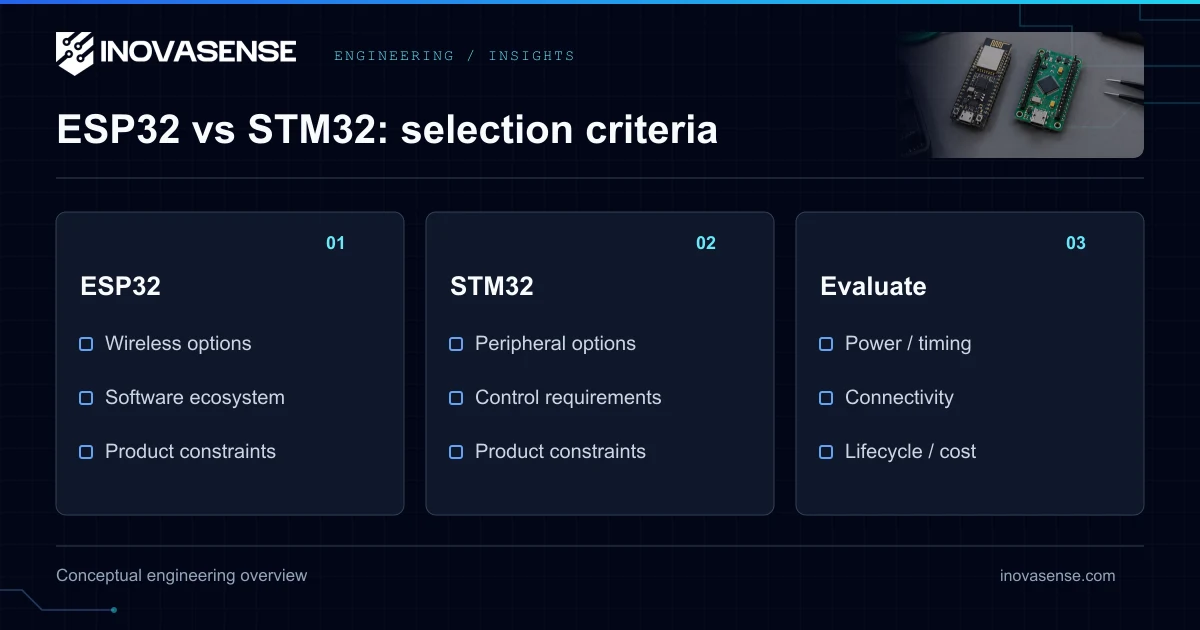
Choose a part number before comparing an ESP32 with an STM32. Both names cover families with different cores, radios and security features. A family-level winner for power, price or performance is not a useful product specification.
Compare concrete devices
| Device | Processor | Connectivity or distinction |
|---|---|---|
| ESP32-S3 | Dual Xtensa LX7, up to 240 MHz | 2.4 GHz Wi-Fi and Bluetooth LE; no native IEEE 802.15.4 |
| ESP32-C6 | RISC-V, high-performance core up to 160 MHz | 2.4 GHz Wi-Fi 6, Bluetooth LE and IEEE 802.15.4 |
| ESP32-P4 | Dual high-performance RISC-V cores, up to 400 MHz | No integrated Wi-Fi/Bluetooth radio; a companion can provide wireless connectivity |
| STM32L476 | Cortex-M4, up to 80 MHz | Low-power MCU; classic CAN, not CAN FD |
| STM32H747 | Cortex-M7 up to 480 MHz plus Cortex-M4 | Dual-core application processing; these cores do not provide Arm TrustZone |
| STM32WB55 | Cortex-M4 plus Cortex-M0+ | Wireless subsystem for supported Bluetooth LE/802.15.4 stacks; not Cortex-M33 TrustZone |
| STM32WBA5 | Cortex-M33, up to 100 MHz | TrustZone and wireless capabilities; verify the exact variant and supported stack |
These are selected examples, not the entire catalogues. Verify the datasheet revision, package, pin allocation and errata before ordering. Wi-Fi does not imply Thread support: Thread uses IEEE 802.15.4. Matter can use Wi-Fi or Thread, and radio capability alone does not provide a complete Matter implementation.
Measure battery life on the complete design
Sleep-current figures do not describe an active wireless product. Compare identical sensor sampling, payload size, transmit power, network conditions, reconnect behaviour and battery chemistry. Include regulators, sensors, LEDs and leakage on the actual board.
A first-order energy budget sums each operating mode’s current multiplied by its fraction of time. Refine it with measured wake-up and transmit events, battery self-discharge and usable capacity across temperature. A deep-sleep datasheet number cannot justify a claim that one family lasts years and another weeks. Measure both candidates with the same application firmware and report the test conditions.
Connectivity and product compliance
For a Wi-Fi endpoint, an ESP32 device with the required integrated radio can reduce the number of components. For motor control, specialised timers, analogue acquisition or industrial interfaces, shortlist exact STM32 and ESP32 parts against the specification. For a Bluetooth-only sensor, compare appropriate wireless MCU variants rather than a Wi-Fi workload against a BLE workload.
A tested radio module can supply useful evidence and reduce RF design work. It does not make the complete product automatically CE compliant or guarantee weeks saved. Antenna, enclosure, power supply, interfaces and intended use affect the assessment under the RED. Reuse evidence only within its tested configuration and scope.
Security, software and lifecycle cost
Secure boot, flash protection and key storage differ by device and configuration. Cortex-M4/M7 and Cortex-M33 are not interchangeable security architectures. Check the complete boot and update chain, provisioning, recovery, debug access and vendor security advisories. A chip’s security certification does not establish product conformity.
Evaluate ESP-IDF or the relevant STM32 tools with a representative prototype: peripheral drivers, RTOS integration, libraries, licences, debugging and update maintenance. A functional-safety tool or component certificate covers a defined scope, not the finished product.
Request dated quotations for the exact part, package, volume and delivery terms. Include external radio, memory, power circuitry, test effort and software maintenance in the BOM decision. Check each supplier’s published longevity commitment for that part; generic three-year versus ten-year family claims are unreliable.
A practical decision process
- Define interfaces, timing, connectivity and environmental limits.
- Select two or three exact devices and verify errata and supply commitments.
- Prototype the hardest processing and communication paths.
- Measure energy, latency and recovery under the same conditions.
- Compare quoted total costs and the lifecycle update plan.
Embedded systems development · CRA checklist · Discuss your MCU selection
Frequently asked questions
Does every ESP32 include Wi-Fi and Bluetooth?
No. ESP32 devices differ: ESP32-S3 includes Wi-Fi and Bluetooth LE, ESP32-C6 also supports IEEE 802.15.4, while ESP32-P4 has no integrated Wi-Fi/Bluetooth radio. Check the exact part.
Is STM32 always more energy efficient than ESP32?
No. Compare exact devices using the same application, duty cycle, radio conditions and full-board measurement. Sleep current alone does not determine battery life.
Do STM32H747 and STM32WB55 have Arm TrustZone?
No. STM32H747 uses Cortex-M7/M4 and STM32WB55 Cortex-M4/M0+. Selected Cortex-M33 devices, including STM32WBA5, provide TrustZone; verify the chosen part.
Does a radio module remove CE assessment of the final product?
No. Module evidence can be reused within its applicable scope, but the manufacturer must assess the integrated product, including antenna, enclosure, power supply and interfaces.
Primary sources
Technical and regulatory references checked on 1 October 2026.
Related guides inEmbedded Systems Development
Explore all →Embedded Programming: Engineer's Guide
Embedded programming guide — bare-metal C on Cortex-M, RTOS design, JTAG debugging, and TinyML. Updated for 2026 with Rust and RISC-V.
RISC-V vs ARM: Embedded Architecture
RISC-V vs ARM comparison for embedded engineers. ISA differences, real benchmarks, ecosystem maturity, costs, and EU sovereignty implications.
IoT Explained: Technical Deep-Dive
IoT connects devices via sensors, MCUs, and wireless protocols for real-time data. How it works — from silicon to cloud in 2026.