
What is the Internet of Things (IoT)?
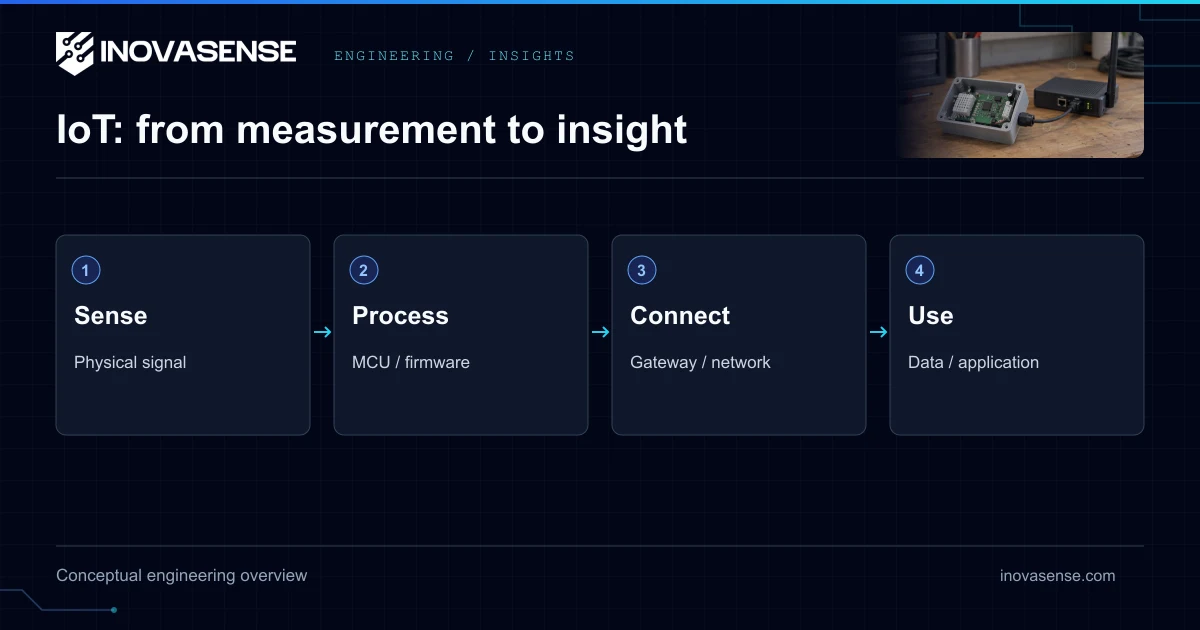
The Internet of Things (IoT) is a network of physical devices embedded with sensors, microcontrollers, and wireless connectivity that collect, process, and exchange data without human intervention. An IoT system typically consists of four layers: the device layer (sensors + MCU), the connectivity layer (wireless protocol), the platform layer (cloud/edge processing), and the application layer (dashboards, alerts, automation).
As of early 2026, there are an estimated 21.2 billion IoT connections globally (IoT Analytics), with the fastest growth in industrial IoT (IIoT), smart energy, and connected health. The EU Cyber Resilience Act deadline (December 2027) is now accelerating a wave of IoT hardware redesigns across every sector.
How Does an IoT Device Actually Work?
At the hardware level, a typical IoT sensor node consists of:
- Sensor(s) — Temperature (±0.1°C, e.g., TI TMP117), humidity, pressure, motion, light, or application-specific transducers
- Microcontroller — Low-power processor (e.g., STM32U5 at 160 MHz, 110 nA in shutdown mode) that reads sensor data, runs local logic, and manages power
- Wireless module — BLE, LoRaWAN, NB-IoT, Wi-Fi, or Thread radio for data transmission
- Power source — Battery (CR2032, 2×AAA, LiPo), energy harvesting (solar, thermal), or wired power
- Secure Element — Dedicated tamper-resistant IC (e.g., Infineon OPTIGA Trust M, NXP SE050) for hardware-rooted key storage — now required for CRA-compliant products
The MCU wakes periodically (e.g., every 15 minutes), reads sensor data, optionally runs local processing (thresholds, filtering, on-device ML inference), transmits a compact data packet (typically 10–50 bytes), and returns to deep sleep to conserve power.
Choosing the Right Connectivity Protocol
The choice of wireless protocol is the most consequential architecture decision in IoT design:
| Protocol | Range | Data Rate | Power | Battery Life | Monthly Cost | Best For |
|---|---|---|---|---|---|---|
| BLE 5.4 | 100 m | 2 Mbps | Ultra-low | 2–5 years | €0 (no subscription) | Wearables, proximity, asset tags |
| LoRaWAN | 2–15 km | 0.3–50 kbps | Very low | 5–10 years | €0.5–2/device | Environmental monitoring, agriculture, metering |
| NB-IoT | Cellular | 250 kbps | Low | 3–5 years | €1–5/device | Wide-area tracking, remote assets |
| LTE-M | Cellular | 1 Mbps | Low–Medium | 2–4 years | €2–5/device | Mobile assets, voice, higher throughput |
| Wi-Fi 6E/7 | 50 m | 2.4–46 Gbps | Medium–High | Wired/short | €0 | Cameras, gateways, high-bandwidth |
| Thread/Matter 1.3 | 30 m mesh | 250 kbps | Low | 2–5 years | €0 | Smart home, building automation |
| 5G RedCap (Rel-17) | Cellular | 150 Mbps | Medium | 1–3 years | €5–10/device | Industrial IoT, video, AR |
| DECT NR+ (NR+) | 1–5 km mesh | 3 Mbps | Low | 3–7 years | €0 | Smart metering, building infrastructure |
Rule of thumb: If you need multi-kilometer range with battery life >5 years, choose LoRaWAN. If you need cellular coverage without deploying infrastructure, choose NB-IoT or LTE-M. If you need high bandwidth and have power available, choose Wi-Fi 6E/7. New in 2026: DECT NR+ is gaining traction for license-free mesh deployments in the 1.9 GHz band — especially for smart metering and building infrastructure across the EU.
IoT Application Protocols
Once data reaches a gateway or cloud endpoint, application-layer protocols handle message routing:
- MQTT 5.0 (Message Queuing Telemetry Transport) — Publish/subscribe pattern, lightweight (2-byte header), with v5.0 adding shared subscriptions, message expiry, and topic aliases. Used by AWS IoT Core, Azure IoT Hub, and most IoT platforms
- CoAP (Constrained Application Protocol) — REST-like request/response over UDP, designed for extremely constrained devices and lossy networks. Gaining relevance in LPWAN deployments
- LwM2M 1.2 (Lightweight M2M) — OMA standard for device management, firmware OTA, and telemetry on resource-constrained devices. Version 1.2 adds MQTT transport and composite operations
- HTTP/REST — Standard web APIs for unconstrained gateways and edge devices with sufficient resources
- Sparkplug B — MQTT-based specification for industrial IoT, providing standardized topic namespaces and payload encoding for SCADA/MES integration
What Industries Benefit Most?
| Industry | IoT Application | Typical ROI |
|---|---|---|
| Smart Buildings | Occupancy sensing, HVAC optimization, energy monitoring, ESG reporting | 15–30% energy cost reduction |
| Agriculture | Soil moisture, weather stations, irrigation automation, livestock tracking | 20–40% water savings |
| Logistics | Asset tracking, cold chain monitoring, fleet telematics, customs digitization | 10–25% fuel savings, 99.5% shipment visibility |
| Manufacturing (IIoT) | Predictive maintenance, OEE monitoring, quality inspection, digital twins | 15–30% reduction in unplanned downtime |
| Smart Cities | Waste bin fill level, parking occupancy, air quality, noise mapping | 30–50% collection cost reduction |
| Healthcare | Remote patient monitoring, asset tracking, environmental compliance | Reduced readmissions, regulatory compliance |
| Energy & Utilities | Smart metering, grid edge intelligence, EV charging management | 10–20% demand response improvement |
IoT Security: The Non-Negotiable Layer
IoT security is a regulatory requirement, not an option. The EU Cyber Resilience Act (EU 2024/2847) mandates that all connected products sold in the EU must implement — by December 2027:
- Secure boot — Cryptographic verification of firmware at every startup
- Authenticated OTA updates — Signed firmware packages with rollback protection
- Unique device identity — Per-device credentials provisioned during manufacturing, no shared secrets or default passwords
- Vulnerability management — Documented process for handling and disclosing security vulnerabilities throughout the product lifecycle (minimum 5-year support obligation)
- Software Bill of Materials (SBOM) — Machine-readable inventory of all software components, required for vulnerability tracking
Hardware-rooted security (Secure Elements like NXP SE050, Infineon OPTIGA Trust M, Microchip ATECC608B) provides tamper-resistant key storage that software-only solutions cannot match. For a comprehensive guide to hardware security implementation, see our Hardware Security Deep-Dive.
The Scale of IoT in 2026
The numbers continue to grow: IoT Analytics projects 32+ billion connected devices by 2028. But raw device count is less important than the data these devices generate. A single industrial sensor transmitting a 20-byte packet every 10 seconds generates 63 MB/year — multiply by thousands of sensors, and the data management challenge becomes clear.
This is why edge computing and Edge AI are becoming essential: processing data locally reduces bandwidth, latency, and cloud costs, while improving privacy and reliability. In 2026, an increasing share of IoT nodes run on-device ML inference — enabled by MCUs like the STM32N6 with dedicated NPU accelerators, delivering sub-millisecond classification without cloud dependency.
Our IoT Project Management Approach
Inovasense manages IoT hardware projects from concept through production — coordinating specialized EU-based engineering partners for sensor selection, PCB design, firmware development, cloud integration, and CE/CRA certification. Our NB-IoT Postbox Sensor deployed across European postal networks is one example of end-to-end project delivery. Contact us to discuss your IoT project.
Sources & Official References
- Cyber Resilience Act — Regulation (EU) 2024/2847 — EUR-Lex (Official Journal of the EU)
Related guides inEmbedded Systems Development
Explore all →Embedded Programming: Engineer's Guide
Embedded programming guide — bare-metal C on Cortex-M, RTOS design, JTAG debugging, and TinyML. Updated for 2026 with Rust and RISC-V.
ESP32 vs STM32: Which MCU for Your Next Product?
Compare specific ESP32 and STM32 devices: connectivity, CPU architecture, battery measurements, security, software support and total product cost.
RISC-V vs ARM: Embedded Architecture
RISC-V vs ARM comparison for embedded engineers. ISA differences, real benchmarks, ecosystem maturity, costs, and EU sovereignty implications.