
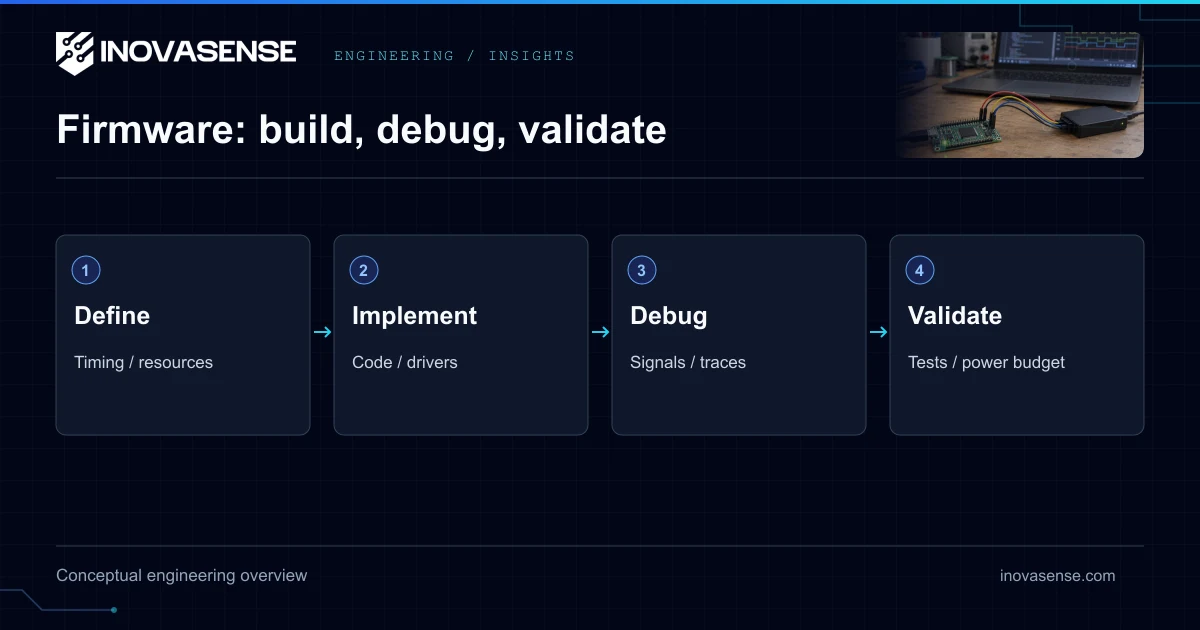
What is Embedded Programming?
Embedded programming is the specialized practice of writing low-level software that runs directly on microcontrollers (MCUs) or FPGAs to control hardware without a general-purpose operating system. It requires deep knowledge of registers, memory management, and hardware security to ensure real-time performance. The dominant languages are C (~65%) and C++ (~20%), with Rust gaining rapid adoption for safety-critical applications.
Here’s a scenario that every embedded engineer has lived through at least once:
It’s 2 AM. Your firmware has been running flawlessly in the lab for 72 hours. You deploy ten units to the field. Within 48 hours, three devices are locked up — no crash dump, no error log, no way to reproduce it on the bench. Your logic analyzer shows clean signals. Your debugger can’t attach without resetting the chip. And your customer’s deadline is Monday.
Welcome to embedded programming — where the bugs don’t care about your unit tests, the hardware fights back, and “it works on my bench” is the most dangerous sentence in engineering.
This guide is not another textbook introduction. It’s a field manual built from thousands of hours of shipping real products — from factory-floor sensors that run for 5 years on a coin cell to automotive ECUs that process CAN messages every 50 microseconds. Whether you’re writing your first main() on an Arduino or architecting a multi-core Cortex-A system with Yocto Linux, this guide will make you a better embedded engineer.
What Makes Embedded Programming Different
Embedded programming isn’t just “programming but smaller.” It’s a fundamentally different discipline with its own physics:
💻 Application Programming
- Infinite RAM (virtual memory)
- OS handles scheduling, I/O, memory
- Crash? Restart the process
- Debug with breakpoints and logs
- Deploy via app stores or Docker
- Performance measured in "fast enough"
🔧 Embedded Programming
- 64 KB RAM (or less) — every byte matters
- You ARE the OS — you write the scheduler
- Crash? Device is bricked in a field 200 km away
- Debug with oscilloscopes and JTAG probes
- Deploy via JTAG flash or signed OTA updates
- Performance measured in microseconds
The most fundamental difference? Timing is not optional. When your motor control loop misses its 50 µs deadline, the motor doesn’t politely wait — it judders, overheats, or stalls. When your airbag controller takes 1 ms too long to fire, someone gets hurt. Embedded programming is where software meets physics, and physics always wins.
Choosing Your Processor: The Decision That Shapes Everything
The first decision in any embedded project determines every decision that follows. Choose wrong, and you’ll spend months fighting a platform instead of building a product:
| Platform | Example | Clock | RAM | When to Choose |
|---|---|---|---|---|
| 8-bit MCU | ATmega328P, PIC18 | 16–20 MHz | 2–8 KB | Simple sensors, legacy products, extreme cost pressure (<€0.30/unit) |
| 32-bit MCU | STM32F4 (Cortex-M4) | 168 MHz | 192 KB | The workhorse — motor control, industrial I/O, BLE devices |
| High-perf MCU | STM32H7 (Cortex-M7) | 480 MHz | 1 MB | DSP, TinyML inference, real-time audio/video processing |
| Application Processor | i.MX 8M (Cortex-A53) | 1.8 GHz | External DDR | Linux-based systems, multi-camera, GUI, networking stacks |
| FPGA SoC | Zynq-7000 (A9 + fabric) | 866 MHz + FPGA | External DDR | Custom datapath + software — when MCUs aren’t fast enough |
War story: We once inherited a project where the original team chose an i.MX 8M application processor for what was essentially a sensor node that reads an ADC and transmits one value per second. The BOM cost was €35 when it should have been €3. The boot time was 12 seconds when it should have been 50 ms. The power consumption was 2W when the battery budget was 50 µA. Choosing the right platform isn't an optimization — it's a survival decision.
The Real Decision: Bare-Metal, RTOS, or Linux?
-
Bare-metal (no OS) — For applications with <5 concurrent tasks and hard real-time requirements. You write the main loop, the interrupt handlers, and the state machines. Total control, total responsibility. Best for: battery-powered sensors, simple actuators, timing-critical signal processing.
-
RTOS (FreeRTOS, Zephyr, ThreadX) — When you need more than one task running concurrently with predictable priorities. The RTOS handles preemptive scheduling, inter-task communication (queues, semaphores), and timer management. Best for: most IoT devices, industrial controllers, communication stacks.
-
Embedded Linux (Yocto, Buildroot) — When you need networking stacks (TCP/IP, Wi-Fi), filesystem management, display/GUI, or need to run third-party libraries. Gives up hard real-time guarantees but gains an enormous ecosystem. Best for: gateways, HMI panels, edge computing, multi-camera systems.
Languages: Why C Still Rules (and Why Rust is Coming for the Crown)
The embedded world runs on C. Not because it’s trendy — because it maps directly to what the hardware actually does:
// This is not abstraction — this IS the hardware
// Setting bit 5 of GPIOA output register = putting 3.3V on physical pin PA5
GPIOA->ODR |= (1 << 5);    // LED turns on. Right now. In one clock cycle.
Every line of C compiles to a predictable sequence of machine instructions. There’s no garbage collector pausing your motor control loop. No virtual method dispatch adding 200 ns of latency to your interrupt handler. No hidden allocations fragmenting your 64 KB of RAM.
C dominates (~65% of embedded projects, 2025 Embedded Market Study) because:
- Direct hardware access — Pointers, bitwise operations,
volatilequalifiers for register manipulation - Deterministic memory — No garbage collector; you allocate, you free, you know exactly what’s happening
- Zero runtime overhead — Compiled code runs directly on the CPU, no VM or interpreter
- Toolchain maturity — GCC, IAR, Keil MDK have decades of optimization for ARM, RISC-V, AVR
C++ adds (~20% of projects) object-oriented abstractions, templates, and RAII patterns for resource management — particularly valuable for larger codebases where C’s lack of namespaces and type safety become liabilities.
The Rust Revolution
Rust is the most significant language shift in embedded programming in 30 years. It delivers C-level performance with compile-time memory safety — no null pointer dereferences, no buffer overflows, no data races. In safety-critical and security-sensitive applications, this isn’t just convenient; it’s potentially transformative.
// Rust embedded — type-safe, zero-cost abstraction, compile-time ownership checking
#[entry]
fn main() -> ! {
    let dp = pac::Peripherals::take().unwrap();  // Singleton — can't accidentally access twice
    let gpioa = dp.GPIOA.split();
    let mut led = gpioa.pa5.into_push_pull_output();

    loop {
        led.set_high();     // Type system guarantees this is a valid output pin
        delay_ms(500);
        led.set_low();
        delay_ms(500);
    }
}
The embedded-hal ecosystem provides hardware abstraction layers for major MCU families. In 2026, Rust embedded is production-ready for new projects — Ferrocene (the safety-certified Rust compiler) achieved ISO 26262 ASIL D and IEC 61508 SIL 4 qualification.
Our take: We use C for projects porting existing codebases or targeting MCUs with limited Rust toolchain support. For new projects — especially anything security-critical or CRA-regulated — we evaluate Rust first. The compile-time safety guarantees eliminate entire categories of field failures that are costly to debug and patch on deployed hardware.
RTOS: The Heartbeat of Embedded Systems
An RTOS isn’t just “a small operating system.” It’s a contract about time: the guarantee that your highest-priority task will execute within a bounded number of microseconds, no matter what else is happening.
Why You Need an RTOS (and When You Don’t)
Consider a sensor node that must simultaneously:
- Read an accelerometer at exactly 1 kHz (every 1,000 µs)
- Process BLE packets when they arrive (unpredictable timing)
- Log data to flash when the buffer fills (every ~10 seconds)
- Go to deep sleep between events to preserve battery
In bare-metal, you’d juggle this with interrupt priorities, flags, and a state machine in while(1). It works for 3 tasks. At 6 tasks, it becomes an unreadable mess. At 10 tasks, it’s unmaintainable.
An RTOS makes this clean:
// FreeRTOS — each concern is its own task with explicit priority
void vAccelerometerTask(void *p)  { /* Priority 3 — highest, hard real-time */ }
void vBLETask(void *p)            { /* Priority 2 — responsive to radio events */ }
void vLoggingTask(void *p)        { /* Priority 1 — runs when nothing else needs CPU */ }
void vIdleHook(void)              { /* Priority 0 — enters STOP2 mode, 2 µA */ }
RTOS Selection Guide
| RTOS | License | Best For | Safety Certifications |
|---|---|---|---|
| FreeRTOS | MIT | Most IoT devices. Enormous community, AWS integration | SAFERTOS variant: IEC 61508 SIL 3 |
| Zephyr | Apache 2.0 | Nordic BLE, Intel, multi-protocol devices | IEC 61508 path in progress |
| ThreadX (Azure RTOS) | MIT (since 2024) | High-reliability, medical, automotive | IEC 61508 SIL 4, DO-178C DAL A |
| VxWorks | Commercial | Aerospace, defense, medical Class III | DO-178C, IEC 62304, EN 50128 |
| RTEMS | BSD | Space, scientific instruments | Radiation-tolerant variants for LEO/GEO |
RTOS trap #1: Priority inversion. Your high-priority task blocks on a mutex held by a low-priority task. A medium-priority task preempts the low-priority task. Result: your highest-priority task is starved indefinitely by a medium-priority task that has nothing to do with it. This crashed the Mars Pathfinder rover in 1997. Solution: always enable priority inheritance on mutexes. FreeRTOS has it. Use it.
RTOS trap #2: Stack overflow in tasks. Each RTOS task has its own stack, statically allocated. If your task's stack is 512 bytes and you declare a 256-byte local array, one nested function call and you're writing into another task's memory. The crash is non-deterministic and appears as random data corruption. Solution: use uxTaskGetStackHighWaterMark() during development to measure actual stack usage, then add 25% margin.
Debugging: Where Embedded Engineers Earn Their Scars
Embedded debugging is the hardest kind of debugging because the bug and the observation tool share the same hardware. Attaching a debugger changes timing. Adding printf statements changes memory layout. Turning on a LED changes power consumption. You are debugging a quantum system where observation disturbs the state.
The Essential Toolkit
🔌 JTAG/SWD Debugger
Segger J-Link, ST-Link, CMSIS-DAP. Step through code, set breakpoints, inspect registers on the live target. SWD is the 2-wire variant standard on all ARM Cortex-M devices.
📊 Logic Analyzer
Saleae Logic Pro 16. Capture and decode SPI, I²C, UART, CAN, 1-Wire at the electrical level. Indispensable for verifying that your software is actually producing the right bus traffic.
🔋 Power Profiler
Nordic PPK2, Otii Arc. Measure µA-resolution current consumption over time. Essential for battery life optimization — one forgotten peripheral left on in sleep mode can cut battery life from 3 years to 3 weeks.
📡 Oscilloscope
Rigol DS1054Z (budget) or Keysight MSOX. Measure timing, signal integrity, rise/fall times, and analog waveforms. Critical for understanding why your SPI bus works at 1 MHz but fails at 10 MHz.
The Five Hardest Embedded Bugs
These are the bugs that separate junior from senior embedded engineers:
1. The Heisenbug — A timing-dependent bug that disappears when you attach a debugger. The debugger changes execution timing by inserting breakpoints, which pauses the CPU. This eliminates the exact race condition you’re trying to observe. Solution: use GPIO toggle pins and an oscilloscope for non-intrusive timing observation.
2. The DMA conflict — Two peripherals configured to use the same DMA channel or memory region. Works fine when only one is active. Corrupts data unpredictably when both fire simultaneously. Only appears under specific load conditions that are nearly impossible to reproduce in the lab.
3. Stack corruption — A buffer overflow on one task’s stack overwrites another task’s data. The corrupted task doesn’t crash immediately — it runs with wrong values until something catastrophic happens minutes or hours later. The crash dump points to the victim, not the perpetrator.
4. Clock domain crossing — In FPGA/mixed-signal designs, data transferred between different clock domains without proper synchronization. Causes metastability — a logic level that is neither 0 nor 1, yielding different results on each read. Manifests as seemingly random one-bit errors.
5. The 49.7-day overflow — A 32-bit millisecond counter overflows after 2³² ms ≈ 49.7 days. The device runs perfectly in the lab for your 72-hour test. Deploys to the field. Crashes after exactly 7 weeks. Every. Single. Time.
The €200,000 bug: A customer deployed 500 environmental sensors in a smart building. After 50 days, devices started locking up randomly — but only 30% of them, and never on the same day. It took 3 weeks to identify: a uint32_t millisecond timer wrapping around at 49.7 days, combined with a comparison if (now - lastEvent > timeout) that worked correctly during overflow... except when lastEvent was within 1 ms of the overflow boundary, which happened at exactly 3:14 AM and only if the device was actively transmitting at that moment. Total cost: 3 engineer-weeks debugging, 500 OTA updates, and one very unhappy building manager.
Power Optimization: Making Batteries Last Years
For battery-powered IoT devices, power optimization isn’t a nice-to-have — it’s the entire product. The difference between a coin cell lasting 3 months and 5 years is entirely in the firmware:
The Power Budget Mindset
Active mode (sensor read + TX):  15 mA × 200 ms  = 3.0 mA·ms
Sleep mode:                      2.5 µA × 59.8 s = 0.15 mA·ms
                                 ─────────────────────────────
Average current per 60s cycle:   3.15 / 60        = 52.5 µA

CR2032 capacity: 225 mAh
Estimated life: 225,000 / 52.5  = 4,286 hours ≈ 178 days

// But if you forget to disable the ADC before sleep:
Sleep mode with ADC on:          150 µA × 59.8 s  = 8.97 mA·ms
New average:                     11.97 / 60        = 199.5 µA
New battery life:                225,000 / 199.5   = 47 days ← DESTROYED
One peripheral left on in sleep mode cut battery life from 6 months to 47 days. This is why power profiling tools (Nordic PPK2, Otii Arc) are mandatory, not optional.
The Power Optimization Checklist
- Clock gating — Disable peripheral clocks when not in use. An idle SPI module still consumes power if clocked
- Sleep modes — Use the deepest sleep mode possible. STM32L4 STOP2 mode: 1.1 µA with RTC and SRAM retention
- ADC management — Start ADC → sample → stop ADC. Never leave it running continuously
- RF duty cycling — For radio devices, schedule transmissions and use the radio’s sleep mode between events
- Voltage scaling — Run the core at the lowest voltage that supports your required clock speed
- Wake sources — Use hardware interrupts (GPIO EXTI, RTC alarm) for wake-up, not periodic polling
The 2026 Landscape: Three Shifts Reshaping Embedded
🧠 TinyML Everywhere
ML inference is becoming a standard peripheral. MCUs like STM32N6 include dedicated NPUs (600 GOPS). Keyword detection, anomaly detection, and vibration analysis now run on €3 chips at 1 mW. AI is a hardware feature, not a cloud dependency.
🔐 Security-First by Law
The EU Cyber Resilience Act (EU 2024/2847) mandates secure boot, authenticated OTA, and vulnerability management for all connected products sold in the EU. Non-compliance = €15M fines. Security is no longer optional.
⚡ RISC-V Rising
Open-source ISA eliminates licensing costs and enables custom instruction extensions. Espressif ESP32-C3/C6 run RISC-V cores. Microchip PolarFire SoC combines RISC-V + FPGA. Silicon sovereignty without ARM licensing dependency.
Embedded Programming Patterns That Ship Products
After hundreds of embedded projects, these are the patterns that consistently separate prototypes from products:
1. The Watchdog Pattern
// If your firmware hangs, the watchdog resets the chip automatically
// EVERY shipping product must have a watchdog. No exceptions.
IWDG->KR = 0xCCCC;  // Start watchdog
IWDG->KR = 0x5555;  // Unlock registers
IWDG->PR = 4;       // Prescaler: 64
IWDG->RLR = 2500;   // Timeout: ~5 seconds

// In your main loop or RTOS idle hook:
IWDG->KR = 0xAAAA;  // Feed the watchdog — "I'm still alive"
2. The State Machine
Every reliable embedded system is built around state machines. Not classes, not callbacks, not event buses — state machines. They’re testable, debuggable, and predictable:
typedef enum { STATE_INIT, STATE_IDLE, STATE_MEASURE, STATE_TRANSMIT, STATE_SLEEP, STATE_ERROR } State_t;

State_t state = STATE_INIT;

void app_run(void) {
    switch (state) {
        case STATE_INIT:     state = sensor_init()   ? STATE_IDLE : STATE_ERROR; break;
        case STATE_IDLE:     state = rtc_alarm_fired  ? STATE_MEASURE : STATE_IDLE; break;
        case STATE_MEASURE:  state = adc_read_all()   ? STATE_TRANSMIT : STATE_ERROR; break;
        case STATE_TRANSMIT: state = lora_send()      ? STATE_SLEEP : STATE_ERROR; break;
        case STATE_SLEEP:    enter_stop2(); state = STATE_IDLE; break;
        case STATE_ERROR:    error_count++; state = STATE_INIT; break;
    }
}
3. The Ring Buffer
The universal pattern for passing data between interrupt context and main context without dynamic allocation:
#define BUF_SIZE 256  // Must be power of 2
volatile uint8_t buf[BUF_SIZE];
volatile uint16_t head = 0, tail = 0;

// ISR context — runs in microseconds, never blocks
void USART1_IRQHandler(void) {
    buf[head & (BUF_SIZE - 1)] = USART1->RDR;
    head++;
}

// Main context — processes data at its own pace
void process_uart(void) {
    while (tail != head) {
        uint8_t byte = buf[tail & (BUF_SIZE - 1)];
        tail++;
        parse_command(byte);
    }
}
From Bench to Boardroom: Why Embedded Engineering Matters
The global embedded systems market exceeded €120 billion in 2025, with the fastest growth in:
- Automotive — Every modern vehicle runs 100+ ECUs with 100M+ lines of embedded code
- Medical devices — Class III implantables demand IEC 62304 life-cycle processes
- Industrial IoT — Smart factories run on embedded PLCs and edge controllers
- Edge AI — On-device inference eliminating cloud dependency for real-time decisions
The demand for embedded engineers far outpaces supply. The 2025 Embedded Market Study reported that 63% of embedded teams say hiring is their biggest challenge — making embedded programming one of the most valuable and defensible engineering skills in the industry.
How We Do Embedded at Inovasense
At Inovasense, embedded programming is core to every project we deliver. Our approach is built on principles we’ve learned the hard way — through deadlines, field failures, and thousands of hours of oscilloscope staring:
| Practice | What it means |
|---|---|
| MISRA C/C++ | Static analysis on every build — no undefined behavior in production |
| Hardware-in-the-loop CI | Automated tests run on real MCU targets, not just simulators |
| Signed OTA updates | Every firmware binary is signed; the bootloader verifies before flashing |
| Power profiling | Every sleep mode transition is measured — we guarantee battery life specs |
| CRA compliance | Secure boot, vulnerability management, and SBOM for EU market conformity |
From bare-metal firmware on Cortex-M0 to multi-threaded Linux applications on i.MX 8M — we design, build, test, and maintain embedded systems that work in the field, not just in the lab.
Need Embedded Engineering?
From MCU firmware to RTOS architecture to production-ready IoT devices — we ship embedded systems that survive the real world. EU-based. CRA-compliant. Battle-tested.
Discuss Your Project →Sources & Official References
- Cyber Resilience Act — Regulation (EU) 2024/2847 — EUR-Lex (Official Journal of the EU)
Related guides inEmbedded Systems Development
Explore all →ESP32 vs STM32: Which MCU for Your Next Product?
Compare specific ESP32 and STM32 devices: connectivity, CPU architecture, battery measurements, security, software support and total product cost.
RISC-V vs ARM: Embedded Architecture
RISC-V vs ARM comparison for embedded engineers. ISA differences, real benchmarks, ecosystem maturity, costs, and EU sovereignty implications.
IoT Explained: Technical Deep-Dive
IoT connects devices via sensors, MCUs, and wireless protocols for real-time data. How it works — from silicon to cloud in 2026.